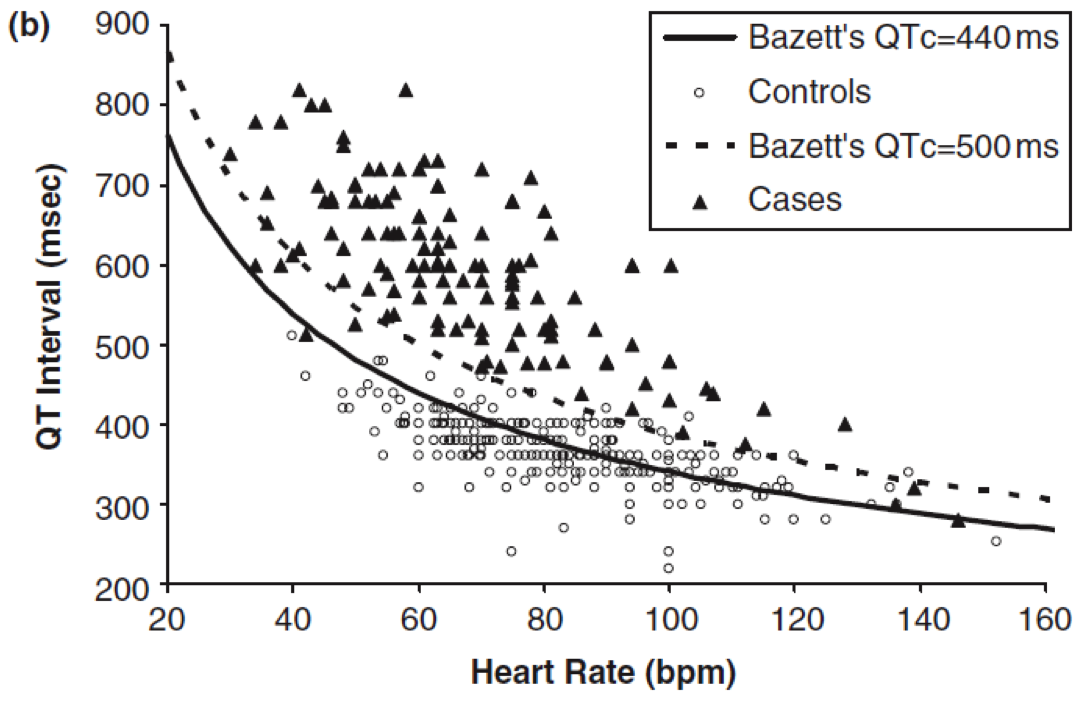
- Cut-off 1 (Bazett's QTc = 500 ms): By selecting this cut-off value, the calculator will have a sensitivity and specificity of 93.8% and 97.2% in detecting torsades des pointes, respectively. This setting aims at reducing the probability of unnecessary cardiac monitoring as much as possible.
- Cut-off 2 (Bazett's QTc = 440 ms): By selecting this cut-off value, the calculator will have a sensitivity and specificity of 98.5% and 66.7% in detecting torsades de points, respectively. This setting aims at reducing the risk of missing torsades des points as much as possible.
- Public
- Cardiology
- {{ modelType }}
- Algorithm
- Details
-
{{ toolbarErrorMessage }}
{{ section.title }}
{{ section.description }}
Calculate the result
ms
Corrected QT interval based on Bazett's formula: ms
Conditional information
Context information:
The aim of the underlying study was to evaluate the performance of the QT nomogram in assessing the risk of TdP, comparing QT-heart rate combinations for known cases of drug-induced TdP cases to those of a negative control group with normal QT-HR values.
Source:
Chan A, Isbister GK, Kirkpatrick CM, Dufful SB. Drug-induced QT prolongation and torsades de pointes: evaluation of a QT nomogram. QJM. 2007;100(10):609-15.
This algorithm is provided for educational, training and information purposes. It must not be used to support medical decision making, or to provide medical or diagnostic services. Read our full disclaimer.
{{ variable.title }}
| {{ (typeof row === 'object') ? row.label : row }} |
Result display
| {{ column }} | |
|---|---|
| {{ row.label }} | {{ value }} |
Please enter a password
A password has to be at least 8 characters.
A password cannot be longer then 64 characters.
Choose a password with at least one capital letter.
Choose a password with at least one special character (@$!%*#?&)
Please agree to the Terms & Conditions and the Disclaimer
Please provide your e-mail address and we'll send you a link to reset your password.
Email Address
Please enter a valid email
If an account was registered with this email address you will receive a recovery link in your mail.
Please use the reset password link in it to set your new password.
Didn't receive the email yet? Please check your spam folder, or resend the email.